|
TachyonUI 1.1.0
High-performance UI for building tools.
|
#include <gui_core/graphics/metal/metal_graphics_context.h>
Classes | |
| struct | Impl |
Public Member Functions | |
| MetalGraphicsContext () | |
| ~MetalGraphicsContext () override | |
| void | SetExternalDevice (const ExternalDevice &external) |
| Render on the host's device and queue instead of making them. | |
| GraphicsAPI | GetAPI () const override |
| The API it presents with; window backends make their windows for it. | |
| std::string_view | GetDeviceName () const override |
| The GPU it renders with, as the driver names it ("NVIDIA GeForce RTX 4070"); empty before Initialize and for a backend without a device. | |
| bool | DeviceLost () const override |
| True once the GPU device is lost; RecreateDevice then makes a new one. | |
| void | SetGpuPreference (std::string_view preference) override |
| Which GPU to render with, when there's more than one: a kind ("integrated", "discrete"), the GPU's number in the log's list of detected GPUs, or part of its name ("radeon"); see ChooseGpu. | |
| void | SetImageSlotCount (uint32_t slots) override |
| 4096 by default, 500,000 at most (an argument buffer's textures). | |
| uint32_t | GetImageSlotCount () const override |
| How many images can be registered at once; 0 when the backend doesn't say. | |
| Result< void > | Initialize (IWindowBackend *windowBackend) override |
| Picks a GPU of the Metal 3 family (the system's default unless the app or TACHYON_GPU asks for another), and makes its queue and the GUI's pipelines from the built-in shaders. | |
| void | Cleanup () override |
| Waits for the GPU and destroys what the backend made, the renderer included. | |
| void | BeginFrame () override |
| Frees what the GPU is done with, and resets the renderer. | |
| Image * | CreateImage (void *data, uint2 size, ImageFormat format, Sampler sampler, bool mipmapped=false) override |
| R8G8B8 is widened to R8G8B8A8 (Metal has no 3-byte format), and R8 and R8G8 in sRGB too (macOS has no sRGB format of fewer channels). | |
| bool | UpdateImageRows (Image *image, uint32_t firstRow, uint32_t rowCount, const void *data) override |
| Writes rowCount rows from firstRow into an image CreateImage made with pixels (not mipmapped): tightly packed in its format, the image's width each. | |
| void | DestroyImageAtEnd (Image *img, DeviceScope scope, const std::source_location &loc=std::source_location::current()) override |
| Destroys the image and deletes the object once the GPU is done with it: for DeviceScope::Frame once it has finished the frames that may have drawn with it, however many frames draw nothing meanwhile; for DeviceScope::Application at Cleanup. | |
| TextAtlasManager * | CreateTextAtlasManager () override |
| A new text atlas manager for the backend. The caller owns it and keeps it past Cleanup. | |
| IWindowContext * | CreateWindowContext (void *nativeWindowHandle, OSWindowHandle osHandle, ID id, int2 size, WindowFlags windowFlags, OnGuiFunc onGui) override |
| nativeWindowHandle is the window's NSWindow: the context adds a view with a CAMetalLayer to it. | |
| void | DestroyWindowContext (IWindowContext *context) override |
| Waits for the context's GPU work and destroys it now; its native window must still exist. | |
| ImageSet * | GetImageSet () const override |
| The images the shaders sample, by ImageIndex. | |
| ImageIndex | RegisterImage (Image *image) override |
| Adds the image to the image set; elements draw it by the returned index. | |
| void | UnregisterImage (ImageIndex index) override |
| Frees the index for reuse; the image stays (DestroyImageAtEnd destroys it). | |
| void | PrepareFrame (StyleManager &styleManager, GradientManager &gradientManager, float elapsedTimeSecs) override |
| The gradient pages into the image set, and the styles uploaded where they changed. | |
| void | RePrepareFrame () |
| PrepareFrame again with its last arguments: a live resize's redraw changes styles. | |
| ImageIndex | RenderScene (ID key, ID window, uint2 size, color4f clear, std::function< void(const ScenePayload &scene)> record) override |
| The scene's color texture (MTLPixelFormatRGBA8Unorm, sampled with Sampler::LinearClampToEdge) and depth (MTLPixelFormatDepth32Float), drawn by record in window's next frame before its UI. | |
| ImageIndex | RegisterExternalImage (void *texture, Sampler sampler) |
| A texture the host renders (an id<MTLTexture>, a 3D viewport) in the image set, for the Image control or a primitive to sample with sampler. | |
| void | UpdateExternalImage (ImageIndex index, void *texture, Sampler sampler) |
| Points an existing index at another texture, for example after a resize. | |
| void | WaitIdle () |
| Waits until the GPU has done all work committed so far. | |
| Impl & | Internal () |
| Library internal: the device, its queue, and what the window contexts draw with. | |
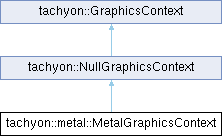
| Public Member Functions inherited from tachyon::NullGraphicsContext | |
| NullGraphicsContext () | |
| ~NullGraphicsContext () override | |
| GraphicsAPI | GetAPI () const override |
| The API it presents with; window backends make their windows for it. | |
| void | SetAllocationHooks (const AllocationHooks &) override |
| Host memory functions for the graphics API's allocations. Call before Initialize. | |
| Result< void > | Initialize (IWindowBackend *windowBackend) override |
| Brings the device up; GUIApplication::Initialize calls it once, before any window context. | |
| void | Cleanup () override |
| Waits for the GPU and destroys what the backend made, the renderer included. | |
| void | BeginFrame () override |
| Starts a frame's UI build: resets the renderer for new primitives (Vulkan: also frees what frame-scoped deletions held long enough). | |
| void | EndFrame () override |
| Ends the UI build, before the uploads and the window contexts' recording. | |
| Image * | CreateImage (void *data, uint2 size, ImageFormat format, Sampler sampler, bool mipmapped=false) override |
| Makes an image from size.x x size.y tightly packed pixels of format (Vulkan: data null for a cleared image); mipmapped generates its mip levels. | |
| void | DestroyImageAtEnd (Image *img, DeviceScope scope, const std::source_location &loc=std::source_location::current()) override |
| Destroys the image and deletes the object once the GPU is done with it: for DeviceScope::Frame once it has finished the frames that may have drawn with it, however many frames draw nothing meanwhile; for DeviceScope::Application at Cleanup. | |
| TextAtlasManager * | CreateTextAtlasManager () override |
| A new text atlas manager for the backend. The caller owns it and keeps it past Cleanup. | |
| IWindowContext * | CreateWindowContext (void *nativeWindowHandle, OSWindowHandle osHandle, ID id, int2 size, WindowFlags windowFlags, OnGuiFunc onGui) override |
| Makes the context that renders an OS window: nativeWindowHandle comes from IWindowBackend::GetNativeHandle, size is in pixels and onGui builds the window's UI. | |
| void | DestroyWindowContext (IWindowContext *context) override |
| Waits for the context's GPU work and destroys it now; its native window must still exist. | |
| ImageSet * | GetImageSet () const override |
| The images the shaders sample, by ImageIndex. | |
| ImageIndex | RegisterImage (Image *image) override |
| Adds the image to the image set; elements draw it by the returned index. | |
| void | UnregisterImage (ImageIndex index) override |
| Frees the index for reuse; the image stays (DestroyImageAtEnd destroys it). | |
| void | PrepareFrame (StyleManager &styleManager, GradientManager &gradientManager, float) override |
| Nothing to upload: takes the style and gradient changes, as a GPU backend's upload does. | |
| uint64_t | RecordedFrames (ID window) const |
| How many frames the window was recorded in (RecordWindowFrame), for tests. | |
| Public Member Functions inherited from tachyon::GraphicsContext | |
| bool | TakeContentChanged () |
| True when something drawn changed since the last call without a draw changing: an image registered or unregistered (a slot reused shows other pixels), or a scene rendered. | |
| GraphicsContext ()=default | |
| virtual | ~GraphicsContext () |
| virtual Result< void > | RecreateDevice (IWindowBackend *) |
| Makes a new device after DeviceLost, and everything the backend owns on it (the window contexts are the caller's to make again). | |
| virtual float | GetLastFrameBuildSeconds () const |
| Wall-clock seconds of CPU work in the last frame: from just after one present returns to just before the next, so without the vsync wait. | |
Static Public Member Functions | |
| static bool | CheckDeviceSupport (void *device, std::string *problems=nullptr) |
| Whether device (an id<MTLDevice>) runs the GUI's shaders; what it lacks, one line each, in problems. | |
Additional Inherited Members | |
| Public Attributes inherited from tachyon::GraphicsContext | |
| GUIRenderer * | guiRenderer = nullptr |
| Where the UI records its draw primitives. | |
| Protected Member Functions inherited from tachyon::GraphicsContext | |
| void | MarkContentChanged () |
| For backends: see TakeContentChanged. | |
| tachyon::metal::MetalGraphicsContext::MetalGraphicsContext | ( | ) |
|
override |
|
static |
Whether device (an id<MTLDevice>) runs the GUI's shaders; what it lacks, one line each, in problems.
It needs the Metal 3 GPU family, for its bindless images.
| void tachyon::metal::MetalGraphicsContext::SetExternalDevice | ( | const ExternalDevice & | external | ) |
Render on the host's device and queue instead of making them.
Call before Initialize, which fails when they can't be used.
|
inlineoverridevirtual |
The API it presents with; window backends make their windows for it.
Implements tachyon::GraphicsContext.
|
overridevirtual |
The GPU it renders with, as the driver names it ("NVIDIA GeForce RTX 4070"); empty before Initialize and for a backend without a device.
Reimplemented from tachyon::GraphicsContext.
|
overridevirtual |
True once the GPU device is lost; RecreateDevice then makes a new one.
Reimplemented from tachyon::GraphicsContext.
|
overridevirtual |
Which GPU to render with, when there's more than one: a kind ("integrated", "discrete"), the GPU's number in the log's list of detected GPUs, or part of its name ("radeon"); see ChooseGpu.
Empty, the default, leaves it to the backend (a discrete GPU first). The TACHYON_GPU environment variable takes its place when set. Call before Initialize. The default does nothing.
Reimplemented from tachyon::GraphicsContext.
|
overridevirtual |
4096 by default, 500,000 at most (an argument buffer's textures).
Call before Initialize.
Reimplemented from tachyon::GraphicsContext.
|
overridevirtual |
How many images can be registered at once; 0 when the backend doesn't say.
Reimplemented from tachyon::GraphicsContext.
|
overridevirtual |
Picks a GPU of the Metal 3 family (the system's default unless the app or TACHYON_GPU asks for another), and makes its queue and the GUI's pipelines from the built-in shaders.
Implements tachyon::GraphicsContext.
|
overridevirtual |
Waits for the GPU and destroys what the backend made, the renderer included.
The window contexts are destroyed before it.
Implements tachyon::GraphicsContext.
|
overridevirtual |
Frees what the GPU is done with, and resets the renderer.
Implements tachyon::GraphicsContext.
|
overridevirtual |
R8G8B8 is widened to R8G8B8A8 (Metal has no 3-byte format), and R8 and R8G8 in sRGB too (macOS has no sRGB format of fewer channels).
mipmapped makes the base level only: the samplers read nothing else, as on the other APIs. The pixels go to the GPU with the next window frame.
Implements tachyon::GraphicsContext.
|
overridevirtual |
Writes rowCount rows from firstRow into an image CreateImage made with pixels (not mipmapped): tightly packed in its format, the image's width each.
As CreateImage's upload, it doesn't wait for the GPU and goes with the next frame, ahead of its draws; the frames already sent draw what they had. False when the backend can't, and the caller makes the image again instead (the default).
Reimplemented from tachyon::GraphicsContext.
|
overridevirtual |
Destroys the image and deletes the object once the GPU is done with it: for DeviceScope::Frame once it has finished the frames that may have drawn with it, however many frames draw nothing meanwhile; for DeviceScope::Application at Cleanup.
Unregister it first (UnregisterImage): no frame may draw with it after this. Any thread. loc is for diagnostics.
Implements tachyon::GraphicsContext.
|
overridevirtual |
A new text atlas manager for the backend. The caller owns it and keeps it past Cleanup.
Implements tachyon::GraphicsContext.
|
overridevirtual |
nativeWindowHandle is the window's NSWindow: the context adds a view with a CAMetalLayer to it.
A render-to-image window's frames are read back.
Implements tachyon::GraphicsContext.
|
overridevirtual |
Waits for the context's GPU work and destroys it now; its native window must still exist.
Implements tachyon::GraphicsContext.
|
overridevirtual |
The images the shaders sample, by ImageIndex.
Implements tachyon::GraphicsContext.
|
overridevirtual |
Adds the image to the image set; elements draw it by the returned index.
Implements tachyon::GraphicsContext.
|
overridevirtual |
Frees the index for reuse; the image stays (DestroyImageAtEnd destroys it).
Implements tachyon::GraphicsContext.
|
overridevirtual |
The gradient pages into the image set, and the styles uploaded where they changed.
Implements tachyon::GraphicsContext.
| void tachyon::metal::MetalGraphicsContext::RePrepareFrame | ( | ) |
PrepareFrame again with its last arguments: a live resize's redraw changes styles.
|
overridevirtual |
The scene's color texture (MTLPixelFormatRGBA8Unorm, sampled with Sampler::LinearClampToEdge) and depth (MTLPixelFormatDepth32Float), drawn by record in window's next frame before its UI.
Reimplemented from tachyon::GraphicsContext.
| ImageIndex tachyon::metal::MetalGraphicsContext::RegisterExternalImage | ( | void * | texture, |
| Sampler | sampler ) |
A texture the host renders (an id<MTLTexture>, a 3D viewport) in the image set, for the Image control or a primitive to sample with sampler.
The texture stays the host's and must outlive every GUI frame that samples it; Metal orders the host's work on the same queue before the GUI's frame. Call it while the UI is built (OnGUI).
| void tachyon::metal::MetalGraphicsContext::UpdateExternalImage | ( | ImageIndex | index, |
| void * | texture, | ||
| Sampler | sampler ) |
Points an existing index at another texture, for example after a resize.
No GUI frame in flight may still sample the old one (WaitIdle).
| void tachyon::metal::MetalGraphicsContext::WaitIdle | ( | ) |
Waits until the GPU has done all work committed so far.
|
inline |
Library internal: the device, its queue, and what the window contexts draw with.
 1.18.0